Thursday, August 30, 2018

Dusky gopher frog reaches Supreme Court

Tom Oates
30 August 2018
Front Ecol Environ, 16 (9): 377
The first case scheduled to be heard in the upcoming session of the US Supreme Court sets the Weyerhaeuser Company (Seattle, WA) against the US Fish and Wildlife Service's (USFWS's) critical habitat designation for the endangered dusky gopher frog (Rana sevosa). The court identifies the questions as: “whether the Endangered Species Act (ESA) prohibits designation of private land as unoccupied critical habitat that is neither habitat nor essential to species conservation”, and “whether an agency decision not to exclude an area from critical habitat because of the economic impact of designation is subject to judicial review”. Supreme Court nominee Brett Kavanaugh could potentially tip the balance of the court, creating a tough environment for the ESA.
(read the full article)


Wednesday, August 1, 2018

Forest “resilience” and the farm bill

Tom Oates
1 August 2018
Front Ecol Environ, 16, (6): 313
On June 21, a 5-year farm bill passed the US House of Representatives with a narrow, partisan 213–211 margin. It incorporates much of the previously House-passed “Resilient Federal Forests Act”, encouraging aggressive forest thinning through salvage logging and eliminating review under the National Environmental Policy Act (NEPA), allowing “categorical exclusions” of areas as large as 30,000 acres.
(read the full article)

Friday, June 1, 2018

Personnel is policy at EPA

Tom Oates
1 June 2018
Front Ecol Environ, 16 (5): 256
Thirty‐seven of 46 political appointees now at the US Environmental Protection Agency (EPA) “previously worked for climate‐change doubters or industry”, according to a list compiled by The Center for Public Integrity (Washington, DC). Commenting on the situation, Yogin Kothari of The Union of Concerned Scientists (Washington, DC) says, “Personnel is policy”.
(read the full article)


Tuesday, May 1, 2018

Bears get a boost in Northern Cascades

Tom Oates
1 May 2018
Front Ecol Environ, 16 (4): 200
Grizzly bear (Ursus arctos horribilis) restoration to the Northern Cascades Ecosystem (NCE) got an unexpected nudge forward when US Interior Secretary Ryan Zinke announced his support during a visit to the area on March 23. A 2014 draft environmental impact statement (EIS) for the restoration had stalled following Zinke's December 2017 directive to stop work as the administration sought to better understand the proposal.
(read the full article)


Monday, April 2, 2018

Alternative facts transform scientists into candidates

Tom Oates
2 April 2018
Front Ecol Environ, 16 (3): 134
Bill Foster (D–IL), a former Fermilab physicist, is the only PhD scientist in the US Congress. Now, an unprecedented number of scientist–candidates are vying to join him. Some 60 scientists, mostly Democrats, have entered congressional races nationwide in the coming mid‐term election, when the entire House of Representatives and one‐third of the Senate will face voters. Meanwhile, about 200 STEM‐experienced candidates are contesting state legislature seats. Coming in the middle of an administration's term, mid‐term elections are often a political referendum on the current President.
(read the full article)

Thursday, March 1, 2018

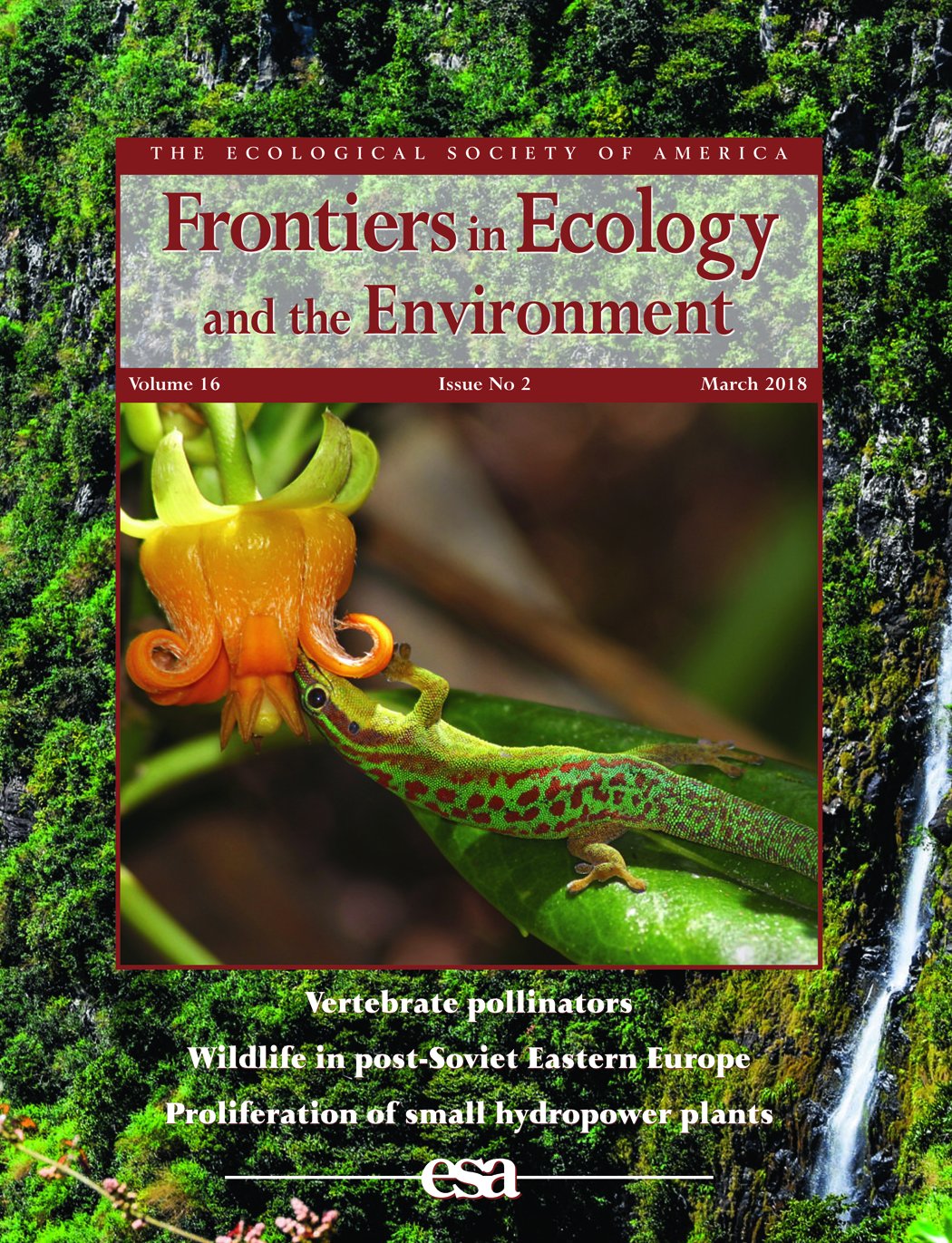
Delisted eastern puma could encourage reintroduction

Tom Oates
1 March 2018
Front Ecol Environ, 16 (2): 66
The eastern puma (Puma concolor couguar) has been determined to be officially extinct by the US Fish and Wildlife Service (FWS) and will therefore be delisted from the Federal List of Endangered and Threatened Wildlife, effective February 22, 2018. The FWS decision, published January 23, noted that outside of Florida, there have been no confirmed sightings of eastern pumas since 1938 and the species had likely been extinct long before its listing in 1973. The Florida panther, considered a distinct subspecies, retains its endangered status.
(read the full article)

Thursday, February 1, 2018

Road access through Izembek wilderness

Tom Oates
1 February 2018
Front Ecol Environ, 16 (1): 6
The Izembek National Wildlife Refuge, Alaska's smallest refuge, is once again facing pressure from local road advocates. King Cove, a city situated in Alaska's Aleutian archipelago and known for its deep‐water harbor, is home to 1000 people and Peter Pan Seafood, the state's largest salmon cannery, employing 500. The refuge isolates them from the nearby, all‐weather airport at Cold Bay. Both maritime and air travel through King Cove can be delayed by harsh conditions, sometimes for days, and there is no connecting road.
(read the full article)